In a previous post, I suggested that we follow the Diploma Track for High School Course of Study. Now, let’s take a closer look at the High School Math Progressions to include on your educational resume (aka transcript).
Think of your transcript as an educational resume that will open the doors of opportunity after graduation. You have to consider what the goal is that your student is aiming for, then work toward that goal.
Four High School Math Credits
Generally speaking, we’re aiming for four credits of math. Homeschool law specifies you’re supposed to “covering” math each year as well. But, “covering” a subject is not necessarily equivalent to the carnegie credits that are listed on the high school transcript.
Math programs are packaged so that whichever Algebra 1 curriculum you choose, it’s similar content. If you start in a program that isn’t working for you student, then it’s okay to switch up to a different one.
My son struggled with Algebra 1 when we used Saxon. It’s a cyclical format that introduces new skills with a few practice problems. And then there’s about 30 review problems. Which is a good thing to keep reviewing and reinforcing previous skills. But, he needed more practice of the new skill (and so did I!)
We ended up splitting the content of Algebra 1 into two full years. We called it Algebra 1A and Algebra 1B. I might also be considers as Pre-Algebra and Algebra 1. When public schools have this on the transcript, it’s called Foundations in Algebra and Intermediate Algebra. It’s equivalent to the content of Algebra 1, with the understanding that it took longer to complete. But, it can be counted as two of the four credits.

High School Math Progressions
Understanding your goal helps when you consider the progressions and variations in your course of study. We don’t want to burn out the student with unnecessarily advanced math, if they struggle in math. But, we also don’t want to put “Math, Math, Math” as the course titles.
We want to show the specific content of the course under this subject category. It is meant to be an accurate reflection of the student’s abilities and accomplishments.
Here’s an example of the progressions from a public school course catalog.
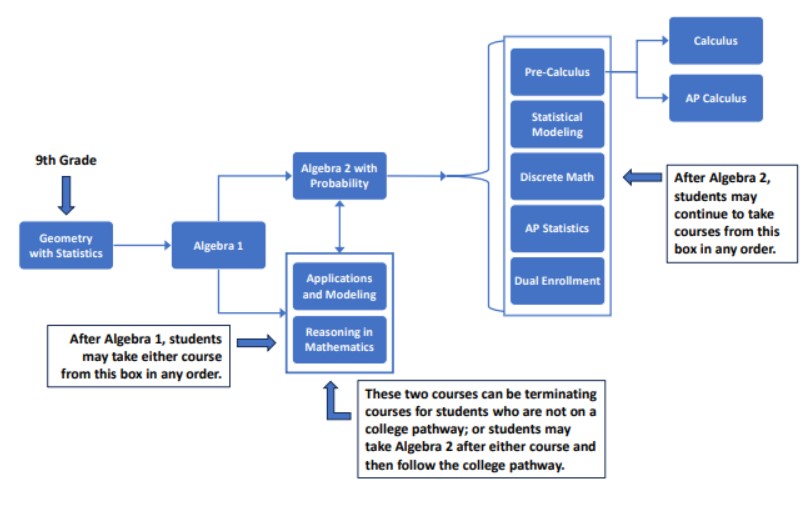
If your student is aiming for freshman admissions at a 4-year university, then you need to look at the math prerequisites for admissions to that specific institution. And if your student is aiming for a Math or Science degree, there may be additional course titles to consider including in your course of study.
If you are not sure where your student wants to go or if they don’t want to go to college. I still recommend following the high school diploma track. You never know if they will change their mind five or ten years down the road.
Freshman Admissions Prerequisites
Freshman admissions for the 4-year University programs usually have these course progressions required prerequisites:
- Algebra 1
- Geometry
- Algebra 2 and
- a 4th higher Math.
Note: Some public schools are changing the order, starting with Geometry, Algebra 1, Algebra 2 and then another higher math.
Pre-Algebra is not considered a high school level course. Usually that credit is done in Middle School. It would not usually be on your course of study if you’re aiming for 4-year University.
However, Pre-Algebra can be counted as a high school credit, if you completed in 9th grade. It counts toward the diploma equivalent for high school graduation. You can spread out the Algebra 1 content over 2 years as Foundations in Algebra and Intermediate Algebra. That’s how my son did it.
If you’re aiming for freshman admissions at a 4-year university, those 2 credits count as the equivalent content of Algebra 1. I have occasionally seen students who changed their mind in 11th or 12th grade about their goals after high school, and then need to add on more advanced math credits. But, you can get to Tech with any 4 math credits, then transfer to the 4-year degree program.
If you did Geometry or Algebra 1 in middle school, those credits need to be included on the transcript. I had a student transcript showing Trigonometry in 9th grade. But, you still should be showing those prerequistes as well.
After Algebra 2, the public school has a variety of course options to consider. Precalculus, Calculus or Probability/Statistics is a common choice for homeschoolers–or Dual Enrollment. Dual enrollment is when you take a college course and it counts as BOTH college credit AND High School credit. A college course that is 3 credit hours in a semester of time is equivalent to 1 full year carnegie credit of high school.
The benefit of taking a college course is that you can also knock off some of the general ed requirements of your degree. So, be sure to check with the university to see what the math credits will transfer into the degree program. You can also search which courses transfer to and from institutions in SC.
Dual enrollment progressions can be confusing though. The course titles, like Precalculus are 200 level classes at college though. That may not even be a course that transfers into your degree program, so it’s unnecessarily skipping to higher advanced levels. If your student takes a College Algebra course counts as the next higher progression, even though it is similar content of the high school level Algebra that you already did.
Many homeschoolers start dual enrollments before the 4th Math. Some who jump right into college classes instead or others who cover the high school credits in middle school. Just be sure you’re checking with admissions about their requirements. I remember one student who did a bunch of college math credits, but didn’t have Geometry–so she had to do add that as a high school course in her senior year.
That’s why I call it an academic resume. If you think of college admissions like applying for a job, then you include the details that are necessary to get accepted (or hired).
Try Mr. D Math for advanced or remedial levels. Self-paced or live classes available, too! Use my affiliate referral link to find out more

Unsure of the Goals?
Now, let’s consider if you don’t know where you want to go to college yet or even if you want to go at all. Your student can still get to a 4-year degree program by transferring from a Technical College. It’s not necessary to stress out and burn out trying to do advanced maths–especially if your student struggles with that.
One family I know, had a grandparent that would pay for college *only if* the student could get accepted to USC as a freshman. But, the girl struggled with the math prerequisites. She would have been able to go to Tech and transfer to the 4-year degree program instead. But, it was an arbitrary standard that was imposed.
My son, who struggled to get thru Algebra 1, ended up with a Master’s Degree in Computer Engineering. He did college level Caluculus as a prerequisite for the grad program, without having even attempted it in high school. I asked him if I should have pushed him harder on his maths, though. And he admits he was not motivated then and had different goals in mind at the time. So, pushing him would have been counter-productive.
I know another family that has a more unschooling approach, so they did more general math, practical math courses. Then, the student decided she wants to go to USC as a freshman, and she’s mapped out a course of study to knock out those admissions requirements.
Definitely include your student in the planning, so they have agency over their course of study. The weight of responsibility begins to shift to the student anyway. You really can’t push them if they aren’t ready or willing, and it risks burning them out if we insist on imposing our own expectations.
Diploma Track Equivalent
If you’re unsure of the goals, then I recommend using the diploma track course of study, which is 4-credits of Math. There is a wide variety of possibilities for those course titles.
- My daughter did Algebra 1, Algebra 2, Geometry and DE College Math. She went to Tech, then transferred to a 4-year degree program and a master’s as well.
- My son did Algebra 1A, Algebra 1B, Geometry and Algebra 2, then went to Tech and transferred to 4-year degree program and a master’s as well.
- Another student did General Math 1, General Math 2, General Math 3, and General Math 4. He went to the military.
- Others do a Business Math or Consumer Math/Practical Math as their 4th Math.
- Some who skip to Probility & Statistics from Pre-Algebra.
I find it helpful to look at public school course catalogs for their course descriptions. The homeschool programs may offer something called Consumer Math, but you can translate it to another course title that matches that similar content.
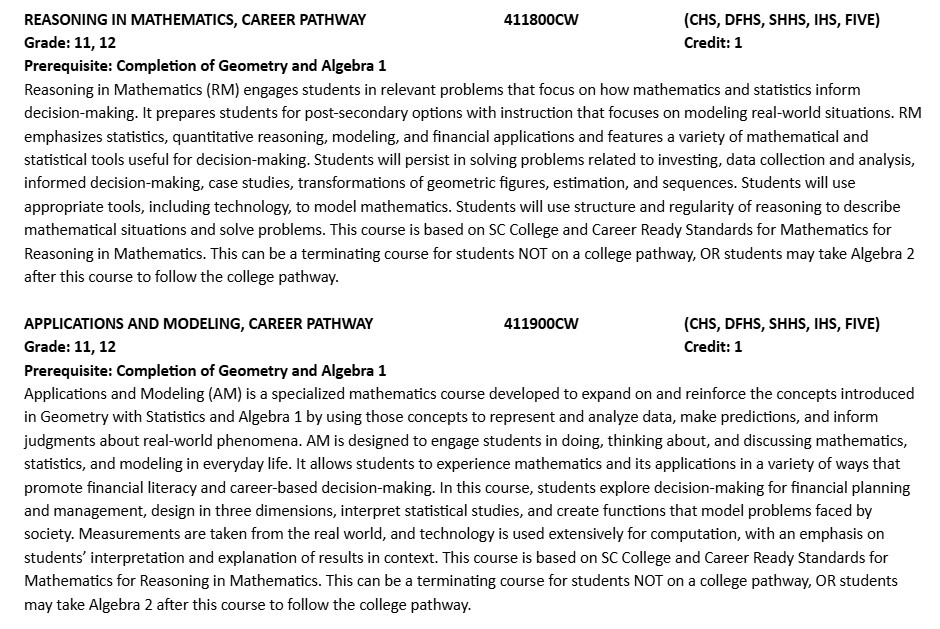
This course catalog example from the public school shows some alternatives for students who are not planning to attend college.
- Applications & Modeling
- Reasoning in Mathematics
The point is to show an accurate reflection of the student’s abilities and accomplishments. It’s ok if they don’t get to Precalculus in High School.
I recommend using the diploma track as a guide so you show an equivalent educational resume to the public school grads. Your homeschool grad is able to open the doors of opportunity in a competitive marketplace.
Read more about Choosing Tech:

 College Preview Days Spring 2018
 College Scholarships
 How to Enroll your Child BACK in School
 Class Ranking Policies: To Rank or Not to Rank?




Speak Your Mind